If you’re standing in the paint aisle staring at five products that all claim to be the best pool deck paint, here’s my first piece of advice: don’t buy anything yet.
I’ve been restoring decks, concrete surfaces, patios, and pool areas around Raleigh and Durham since 2012. The most expensive pool deck mistakes I see usually happen before the first coat goes down. A homeowner buys a good product, puts it over the wrong surface, misses a prep step, gets hit by a North Carolina rainstorm, and suddenly that “weekend project” becomes a stripping project. Cobra has served the Raleigh-Durham area since 2012, and that experience changes how you look at these projects.
This isn’t another ranking of acrylic coatings, epoxy coatings, polyaspartic coatings, and cool deck coating systems. I already wrote a guide comparing those options.
If you want professional results on a concrete pool deck surface, run your project through these seven checks and use my DIY Pool Deck Paint Decision Checklist at the bottom.
1. Make Sure You’re Buying Deck Paint, Not Paint for Inside the Pool
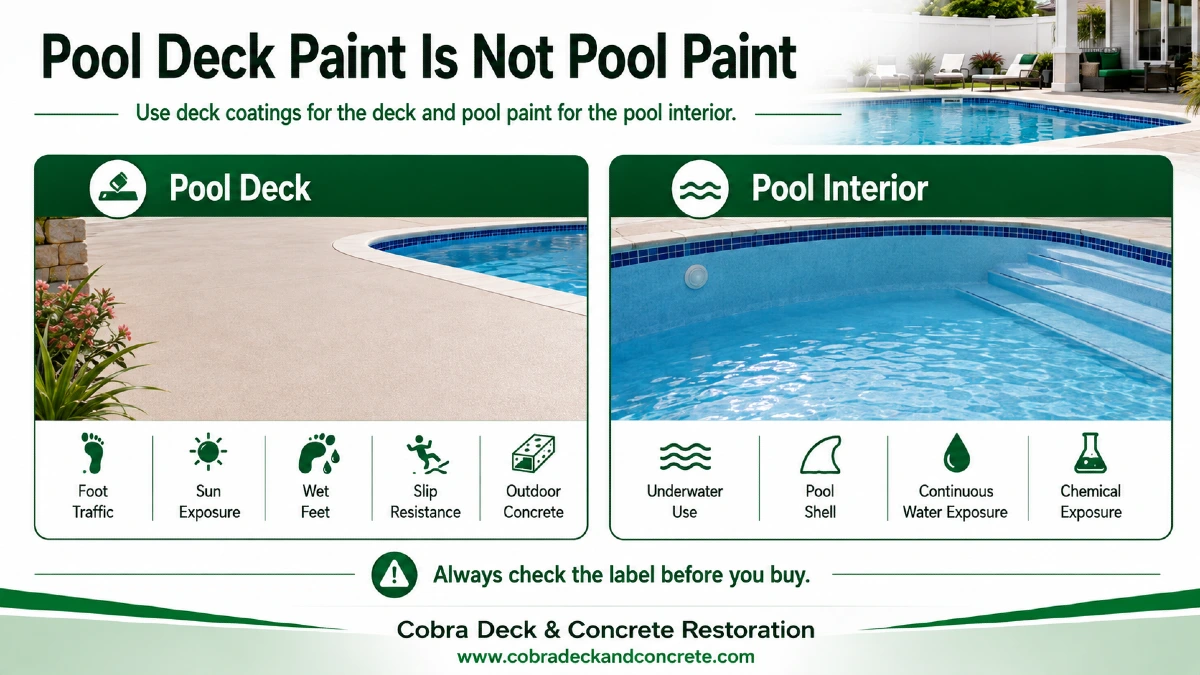
Online search results make this surprisingly easy to get wrong.
Products described as high-build epoxy pool paint, swim epoxy pool paint, epoxy-based pool paint, or swim chlorinated rubber pool paint may be designed for the pool’s surface below the waterline. Manufacturers sell separate epoxy, chlorinated rubber, and acrylic swimming pool paints for concrete, gunite, fiberglass, plaster, and other submerged pool surfaces.
That is a different job from painting or coating outdoor pool decks.
A concrete pool deck coating needs to handle foot traffic, direct sun, water, bare feet, furniture, sunscreen, pool chemicals, and slip resistance. The right product should specifically list exterior horizontal concrete, pool decks, or comparable outdoor use in the product directions. Products such as H&C ACRYLA-DECK, for example, specifically identify pool decks and concrete decks as intended applications.
If the label talks mainly about filling the pool, the deep end drain cover, chlorine shock, or cure time before adding water, you’re looking at swimming pool paint, not concrete pool deck paint. Put it back on the shelf.
2. Figure Out What Is Already on the Concrete

Bare concrete is relatively straightforward. Old concrete with three mystery layers is not.
Before choosing the right coating, determine whether your deck surfaces are bare concrete, sealed concrete, painted concrete, stained concrete, a cementitious cool deck or Kool Deck surface, a concrete overlay, or another type of concrete coating.
Your new coat can only bond as well as the material underneath it. Identifying that surface first is what makes accurate recommendations possible for your specific needs.
In one recent homeowner discussion, an older pool deck had Kool Deck, a skim coat, and acrylic paint layered on top. The upper layers were flaking while the original material remained mostly bonded. Simply rolling on a fresh new look would not solve that underlying problem.
If old material is peeling, blistering, chalking, or releasing in sheets, investigate before covering it.
3. Do the Water Test Before the Color Test

We all love choosing custom colors, especially when a product offers a wide range of colors, but moisture matters more.
Concrete slabs can move moisture through the surface. Sealers, curing compounds, oils, and old coatings can also interfere with adhesion. The International Concrete Repair Institute identifies excessive moisture, insufficient surface preparation, and missed recoat windows among causes of coating debonding.
A simple starting point on bare concrete is to see whether clean water absorbs or beads on top. Beading can indicate an existing sealer or contamination. Some coating manufacturers also specify a plastic sheet moisture test. Sherwin-Williams describes one method that involves sealing plastic over bare concrete and checking underneath for moisture or condensation.
Follow the exact product directions for the system you select. And please remember that “Dry to the touch” and “ready for coating” are not the same thing.
4. Treat Surface Preparation as Half the Project
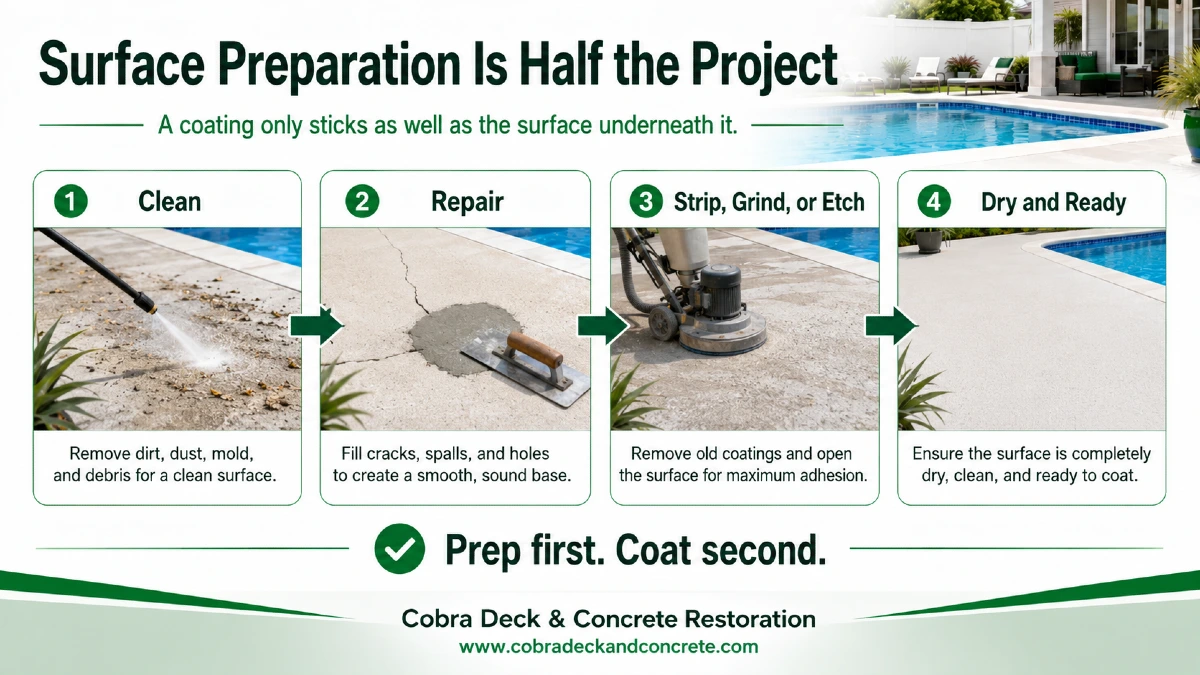
Here’s where DIY projects are won or lost.
Clean surfaces are mandatory, but cleaning alone may not be enough. Depending on the product, surface preparation can include degreasing, power washing, scraping, grinding, stripping old sealer, repairing cracks, or creating a required Concrete Surface Profile.
Some consumer concrete coatings call for etching bare concrete to a texture similar to sandpaper. Higher-build systems can require more aggressive mechanical preparation. MAPEI’s current Mapecoat Deck T instructions, for example, call for clean, sound concrete and a minimum CSP 2 profile.
That is why I would never tell every pool owner to “just acid wash it” or “just pressure wash it.”
If an acid wash or concrete etch is required, follow the manufacturer’s safety and neutralization instructions and protect the swimming pool, landscaping, custom liners, custom covers, metal fixtures, and nearby surfaces.
You’re preparing the bond that has to survive hot days, rain, wet feet, and pool chemicals for, preferably, the next several decades.
5. Calculate the Real Amount of Product
A gallon bucket is not a project plan.
Take the square footage of the pool area, divide it by the manufacturer’s coverage rate, then multiply it by the required number of coats.
One current textured acrylic deck coating specifies about 160 square feet per gallon per coat and recommends two coats. On an 800 square foot concrete deck, that works out to about 10 gallons before allowing for waste, rough texture, or repairs.
And that may only be the coating.
Your real DIY list can include cleaner, crack repair material, stripper, primer if required, traction additive, rollers, protective equipment, grinder or pressure washer rental, and disposal supplies.
Before you select products, price the entire application process. The cheapest deck paint can stop looking cheap quickly.
6. Choose Your Weather Window Like a Contractor
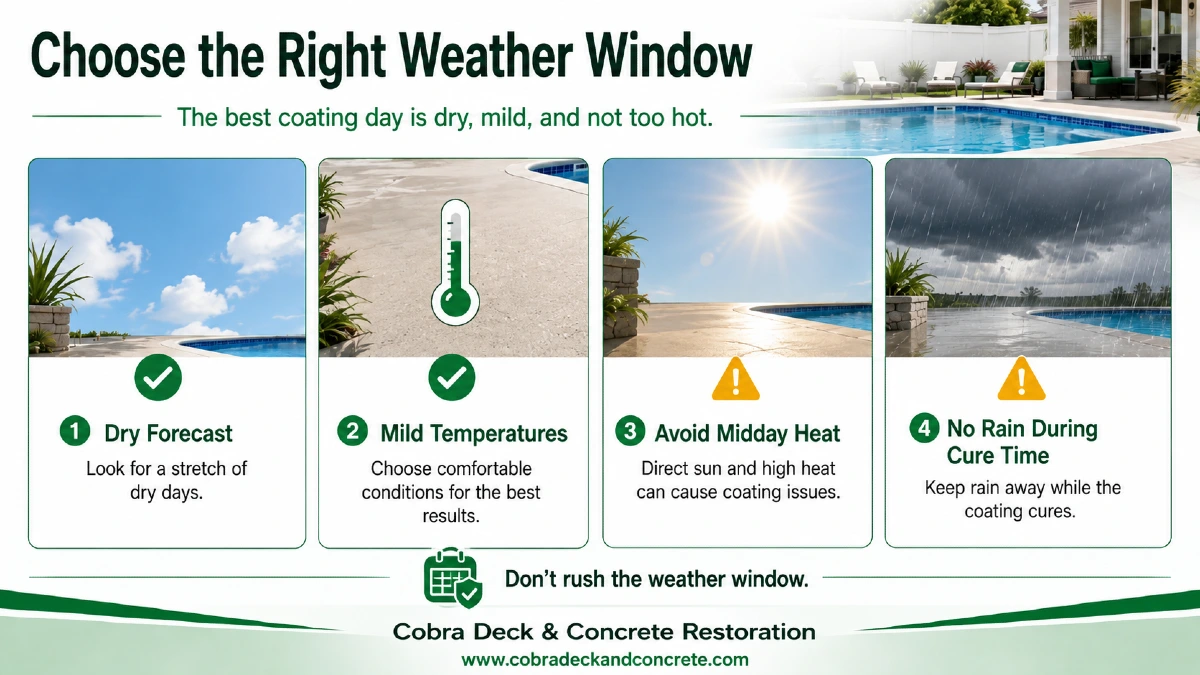
North Carolina makes this interesting.
In Raleigh, Cary, Durham, and Morrisville, a hot summer day can bring intense sun, humidity, and an afternoon storm.
Manufacturers publish air temperature, surface temperatures, humidity, dry time, and recoat requirements for a reason. One acrylic pool coating specifies application between 50 and 90 degrees Fahrenheit and warns against painting in midday sun.
Do not assume the air temperature on your phone matches the concrete surface temperature.
Dark deck surfaces generally create more heat than lighter colors. A cool deck coating or light finish can mean less heat underfoot, but coating chemistry, texture, exposure, and shade all affect surface temperatures. BEHR specifically recommends light and pastel colors for pool deck applications because darker colors retain heat.
For best results, choose the weather window first. Do not force the project into the only Saturday you happen to have free.
7. Decide How Much Slip Resistance You Need
A pool deck is supposed to get wet. Plan for it.
Current ANSI references and model pool codes treat slip resistance as a basic safety issue. The 2024 International Swimming Pool and Spa Code requires decks and similar surfaces to be slip resistant and cleanable. When surfaces are tested using ANSI A326, the code references a wet dynamic coefficient of friction of 0.42.
That doesn’t mean every pool owner needs laboratory equipment.
It means a glossy finish that looks beautiful dry may be wrong for your particular purpose. And someone may get hurt.
Look for textured concrete coatings, compatible traction additives, or systems designed for wet pedestrian areas. But more texture is not automatically better. A rough surface can become uncomfortable on bare feet and harder to clean.
Residential owners should use caution and check current codes and local requirements. HOA, hotel, apartment, municipal, and other commercial pool owners may carry greater legal responsibility and should get expert advice.
DIY Pool Deck Paint Decision Checklist
Before you buy the coating, rent equipment, or block off a weekend, walk through this checklist. If you can’t confidently check most of these boxes, that’s a signal that your pool deck deserves a professional evaluation first and we give those out for free.
- I know exactly what surface I have. I can identify whether my deck is bare concrete, previously painted concrete, sealed concrete, Kool Deck, a concrete overlay, pavers, stone, or another material.
- The existing coating is in good condition. There is no widespread peeling, bubbling, chalking, delamination, or loose material underneath the area I plan to coat.
- I know the new product is compatible with the old one. I am not simply assuming one concrete coating will stick to another.
- The product is made for pool decks. The label or technical data specifically approves it for exterior horizontal concrete or comparable outdoor deck surfaces and not just the pool’s submerged interior.
- I have checked for moisture or existing sealer. Water absorption, moisture testing, and the manufacturer's requirements do not indicate an obvious bonding problem.
- I can complete the required surface preparation. If the manufacturer calls for stripping, grinding, etching, crack repair, or a specific Concrete Surface Profile, I have the tools and experience to do it properly.
- The concrete is structurally sound. I am dealing with cosmetic cracks or normal wear, not significant movement, displacement, sinking, or a drainage problem that paint cannot fix.
- I have enough product for the entire system. My estimate includes square footage, coverage per gallon, the first coat, additional coats, primer when required, texture additives, and reasonable waste.
- I have read the product directions all the way through. I know the mixing instructions, pot life, application temperature, recoat window, cure time, and how long the deck must remain dry.
- The weather gives me enough margin. I am not gambling an uncured coating against a Triangle afternoon thunderstorm, extreme humidity, or overheated concrete.
- I have planned for slip resistance. The finished surface will provide appropriate traction when wet without becoming painfully rough under bare feet.
- I have thought about heat absorption. If the deck receives full afternoon sun, my color and coating choice account for barefoot comfort and surface temperatures.
- I can keep the deck out of service during curing. Kids, pets, patio furniture, sprinklers, pool water, leaves, and foot traffic can stay off it for the required period.
- I know what happens if the project fails. I understand that correcting poor adhesion may mean grinding or stripping the coating back off and not just applying another coat.
- DIY still makes financial sense after prep. I have compared the total cost of materials, rentals, tools, protective equipment, and my time against having the deck professionally cleaned and restored.
My Simple Rule of Thumb Based on 12 Years of Experience
If you checked 12 to 15 boxes, you may have a reasonable DIY project, particularly if you’re working with sound bare concrete and a homeowner-friendly acrylic coating.
If you checked 8 to 11, slow down and investigate the unanswered questions before buying anything.
If you checked fewer than 8, I would have someone experienced look at the deck first.
The goal isn’t to talk you out of doing the work yourself. It’s to keep a pool deck that needs $500 worth of cleaning and restoration from becoming a much bigger coating-removal project because the wrong material went down first.
The Question I’d Ask Before Painting Anything
Does this pool deck actually need paint?
Sometimes the answer is yes.
A worn concrete deck may benefit from a high-quality pool deck coating to improve appearance, traction, or comfort.
Acrylic coatings are a popular choice and can be an excellent choice for approachable DIY work. Meaning, they’re easy to work with and affordable.
Polyaspartic coatings and polyurea coatings can offer excellent durability in the right system (but not all).
And then there’s the even more pricey, cool deck coating system which is helpful when surface temperatures are the biggest concern particularly if you have kids or pets.
But sometimes the best coating is no new coating at all.
A tired concrete deck may just need professional cleaning, restoration, and sealing. At Cobra, our pool deck process starts with inspection and cleaning, then we inspect again for cracks or damage before recommending added protection. We work with concrete, pavers, travertine, stone, wood, and other pool deck materials. I haven’t had a client stump me yet.
Obviously, this is different from walking into a store determined to leave with paint.
When I’d Call a Professional Instead
I’d strongly consider professional help if your deck has multiple old coatings, widespread peeling, unknown sealers, moisture problems, substantial cracks, drainage issues, or a specialty overlay you can’t identify.
I’d also think twice before tackling a large concrete deck if you have never mechanically prepared concrete or worked with a fast curing coating.
You can recover from a crooked brush line.
Recovering from 1,200 square feet of coating that did not bond is another story.
Want the Pool Deck Restored Without Giving Up Your Weekend?
If your pool deck in Raleigh, Cary, Durham, Morrisville, or the surrounding Triangle looks stained, slippery, dirty, or weathered, Cobra Deck & Concrete Restoration can inspect it before you commit to painting it.
We have restored outdoor surfaces across the Raleigh-Durham area since 2012. Our pool deck cleaning and restoration service removes grime, mold, algae, and buildup, then helps determine whether the surface would benefit from sealing, restoration, or a new coating. Cobra also uses pool safe cleaning methods and offers sealing and coating options when the surface needs additional protection.
Sometimes the right pool deck coating is the answer. Sometimes a professional restorative cleaning brings the deck back so well that paint becomes unnecessary.
Contact Cobra Deck & Concrete Restoration for a free inspection and estimate. We serve homeowners and commercial properties throughout the Triangle.