If you’re searching for the best pool deck paint, start with the concrete, not the paint can.
After more than 12 years of restoring decks, patios, concrete, and pool areas across the Raleigh-Durham region, I’ve seen plenty of homeowners repaint a worn deck only to watch the new finish peel, fade, or become slippery.
Usually, the problem wasn’t the color.
It was the surface underneath.
The right pool deck coating depends on your concrete, sun exposure, drainage, foot traffic, maintenance expectations, and how the pool is actually used. In North Carolina, it also needs to handle strong UV exposure, humidity, heavy rain, pool chemicals, and seasonal temperature swings.
Below, I’ll compare polyaspartic coatings, concrete coatings, acrylic coatings, epoxy coatings, cool deck coating systems, and other popular options so you can make an informed decision and if you need help, contact us for a free visit.
Table of Contents
- What Is The Best Pool Deck Paint?
- Pool Deck Paint, Coatings, Sealers, and Resurfacing Are Different
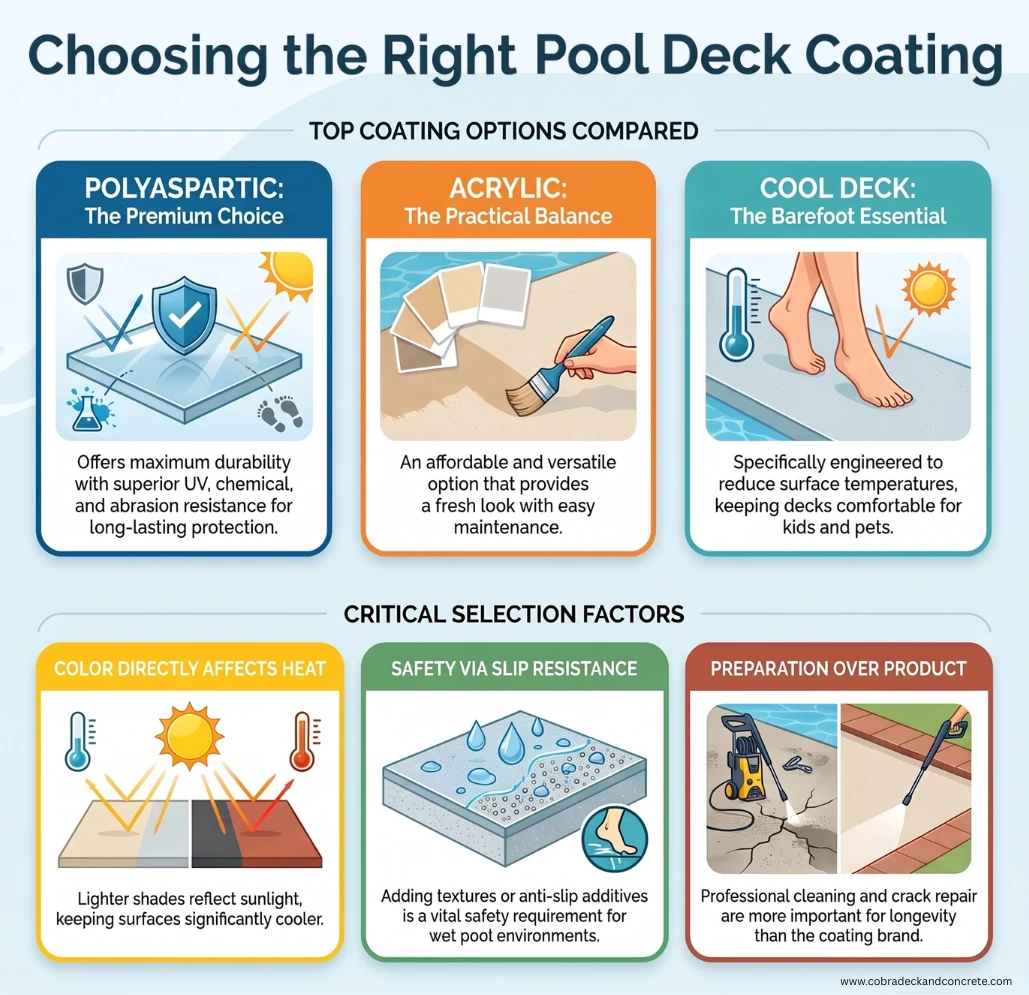
- Best Pool Deck Coating Options Compared
- Polyaspartic Coatings: A Premium Option
- Polyaspartic vs. Polyurea Coatings
- Are Acrylic Coatings Good for Pool Decks?
- Is Epoxy Good for an Outdoor Pool Deck?
- What About Cool Deck Coatings?
- Choose Pool Deck Colors With Heat in Mind
- Slip Resistance Should Be A Priority
- Why North Carolina Pool Decks Need Special Attention
- Surface Preparation Matters More Than the Brand
- Clean Before You Coat
- Can You Paint Bare Concrete?
- Can You Paint Over an Existing Coating?
- What About Cracks?
- Drainage Matters Too
- What About Pool Chemicals?
- Rubber and Metallic Coatings
- DIY or Professional Installation?
- The Cheapest Pool Deck Paint Isn’t Always the Cheapest Option
- Sometimes Restoration Is Better Than Painting
- How I’d Choose a Pool Deck Finish for My Own Home
- Frequently Asked Questions About Pool Deck Paint and Coatings
- Before You Paint Your Pool Deck, Let Cobra Take a Look
What Is the Best Pool Deck Paint?
If you specifically want paint for an exterior concrete pool deck, a quality acrylic coating made for horizontal concrete is often the most practical choice.
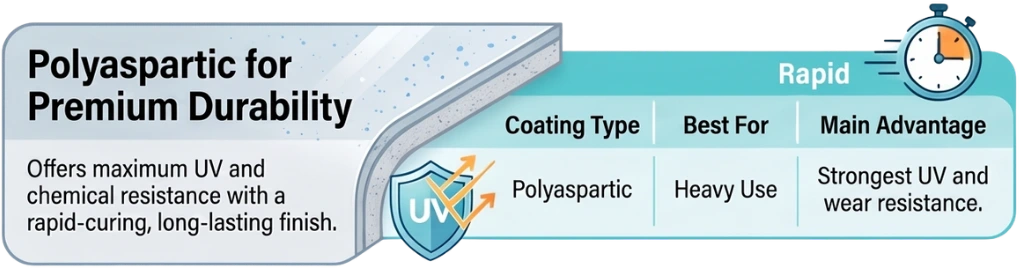
If durability is the priority, polyaspartic coatings are worth considering. Quality polyaspartic systems can provide strong abrasion, UV, and chemical resistance, along with rapid curing and decorative finishes.
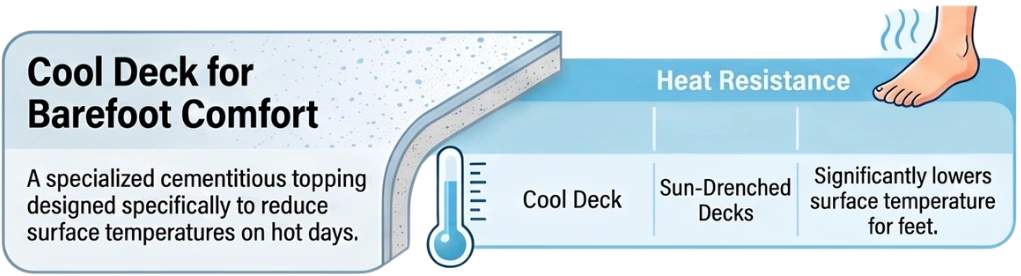
If keeping the deck comfortable under bare feet matters most, a cementitious cool deck coating may be a better fit.
And if you’re considering epoxy coatings, make sure the exact product is approved for exterior use. Many epoxies perform extremely well indoors but can yellow or fade in prolonged direct sunlight.
There is no single best pool deck coating for every home.
There is a best option for YOUR specific deck, and I can’t stress that enough. Every deck is dealing with sunlight, harsh weather conditions, and age differently.
Pool Deck Paint, Coatings, Sealers, and Resurfacing Are Different
First off, perfect pool deck coatings don’t exist. I’ve noticed that most homeowners use “pool deck paint” to describe several very different products, many of which are not paint.
Pool Deck Paint
Traditional deck paint creates a colored film over the surface no different than paint on your walls. Exterior acrylic paints are common because they’re affordable, available in a wide range of colors, and generally easier to apply than advanced resin systems. Paint, no matter how expensive, isn’t the same as a high-quality pool deck coating and every deck is different.
Avoid using ordinary latex paint that isn’t designed for horizontal concrete and outdoor use. That’s my expert advice based on restoring an average of ten decks weekly since I started this company.
Concrete Coatings
Concrete coatings include acrylic, epoxy, polyurea, polyaspartic, decorative flake, quartz, and other resin systems.
These can provide more durability than basic paint, but the application process and surface preparation are usually more demanding.
Concrete Sealers
Sealers protect the surface rather than completely changing its appearance.
For many pool owners, sealing is enough to improve durability, reduce water intrusion, and preserve decorative concrete without covering it.
Pool Deck Resurfacing
Resurfacing adds a new layer or texture over the existing concrete surface.
A true Kool Deck-type system, for example, is a cementitious topping designed to create a cooler, textured finish. It is not simply ordinary pool deck paint.
Knowing what you’re actually shopping for makes the decision less confusing.
Best Pool Deck Coating Options Compared
| Coating Type | Biggest Strength | Main Concern | Best Fit |
|---|---|---|---|
| Polyaspartic coatings | Strong UV, wear, and chemical resistance with fast curing | Surface prep and professional application matter; texture may be needed for wet areas | Homeowners wanting a premium concrete coating and long-lasting protection |
| Acrylic coatings | Affordable, versatile, easy to color | Usually require more maintenance than premium resin systems | Budget-conscious homeowners and many exterior concrete applications |
| Epoxy coatings | Hard, durable finish with good chemical resistance | Many formulations can yellow or fade in direct sunlight | Covered areas or properly engineered exterior systems |
| Polyurea coatings | Tough, flexible, fast-curing options | Product quality and UV performance vary | Heavy-use areas and professionally installed systems |
| Cool deck coatings | Lower surface temperatures and textured barefoot comfort | Not the same as ordinary paint; installation and existing surface matter | Sunny pool decks where heat is a major concern |
| Rubber coatings | Softer feel and potential traction benefits | Appearance, maintenance, and durability vary considerably by product | Specialized applications where cushioning matters |
| Decorative or metallic coatings | Dramatic aesthetic appeal | Dark or glossy surfaces can get hotter and may require added texture | Design-driven areas where barefoot comfort is secondary |
Now let’s get into what those differences actually mean when you’re standing beside a pool in Raleigh or Cary in July.
Polyaspartic Coatings: A Premium Option
Polyaspartic coatings have become a popular choice because they combine durability, UV stability, quick curing, and chemical resistance.
Around a swimming pool, that matters.
A pool deck deals with:
- Chlorine and other pool chemicals
- Wet foot traffic
- Patio furniture
- Direct sunlight
- Rain and humidity
- Temperature changes
- Dirt, sunscreen, leaves, and organic debris
A properly installed polyaspartic system can be an excellent choice for homeowners looking for a premium concrete coating and long-lasting protection.
But there are tradeoffs.
A smooth resin coating can be slippery when wet, so anti-slip additives or another textured finish may be necessary.
Color matters too. Darker colors absorb more heat than lighter colors, which can make the surface uncomfortable on a hot summer day.
A tough coating is only useful if you still enjoy walking on it.
Polyaspartic vs. Polyurea Coatings
Polyurea coatings and polyaspartic systems are often grouped together because both can cure quickly and provide high durability.
But don’t choose based on the chemistry name alone.
Look at the entire system:
- UV resistance
- Base coat and topcoat
- Slip resistance
- Chemical resistance
- Surface preparation
- Moisture tolerance
- Suitability for exterior concrete
The best choice is the system designed for your specific needs, not the one with the most impressive marketing buzzwords.
Are Acrylic Coatings Good for Pool Decks?
Yes.
Acrylic coatings are a great choice for homeowners who want a balance of affordability, color, and ease of maintenance.
They can improve the aesthetic appeal of old bare concrete and are available in a variety of colors.
They’re especially useful when you want to give a tired deck new life without investing in a more expensive resin system.
The downside is longevity.
Acrylic generally requires more maintenance than premium polyaspartic or polyurea systems and may not offer the same abrasion or chemical resistance.
For many homeowners, though, that tradeoff is perfectly reasonable.

Is Epoxy Good for an Outdoor Pool Deck?
Epoxy coatings are extremely durable in the right setting.
They bond well to properly prepared concrete and hold up well in high-traffic areas.
The concern outdoors is UV exposure.
Many epoxies can yellow, chalk, or fade in direct sunlight. A dark epoxy can also absorb too much heat, and a smooth finish will become slippery when wet. That’s basic physics right there.
But that doesn’t mean epoxy is always wrong.
It means you need to verify that the exact type of coating is designed for exterior pool use.
What About Cool Deck Coatings?
If surface temperature is your biggest concern, a cool deck coating deserves a closer look. And I say this not just for adults and kids, but your pets as well. Dogs can burn their paw pads on hot concrete.
True cooling overlays are designed to reduce surface temperatures and make the deck more comfortable on summer days.
That can be a major advantage around pools in the Triangle.
One caution: painting over an existing cool deck surface can change its cooling and slip-resistant properties.
If your existing deck already has a specialized textured surface, identify it before covering it.
Sometimes restoration is smarter than replacement.
Choose Pool Deck Colors With Heat in Mind
Color isn’t only about visual appeal.
It affects comfort.
Lighter colors generally reflect more sunlight and absorb less heat than darker finishes.
That matters in North Carolina, where pool decks can sit in intense direct sunlight for hours.
A deep charcoal finish may look beautiful beside the house but feel much hotter under bare feet than tan, sand, cream, or pale gray.
When choosing a color, think about:
- The look of your pool area
- Heat absorption
- Surrounding landscaping
- Your home’s exterior
- Maintenance
- Sun exposure
The best-looking color isn’t always the most comfortable one.
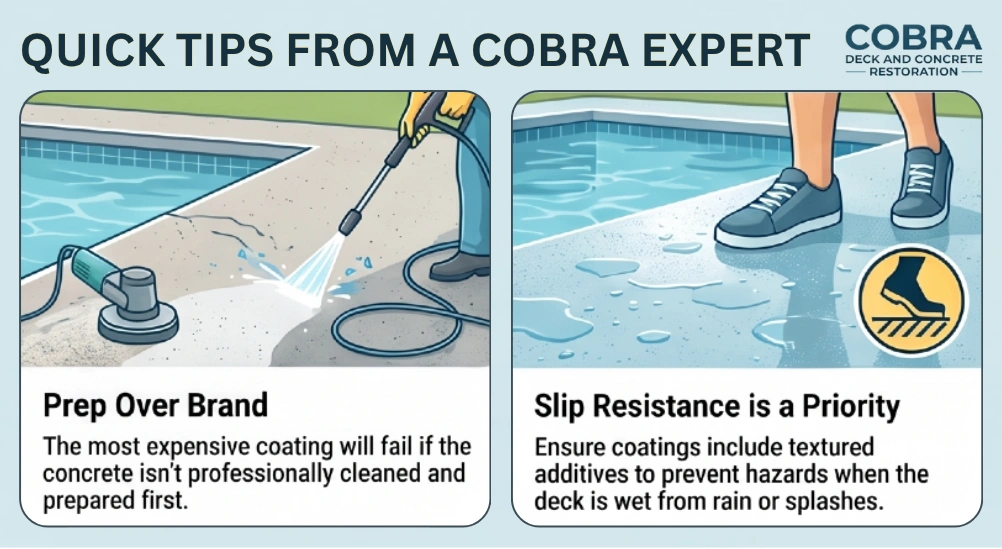
Slip Resistance Should Be A Priority
Around a pool, slip resistance is a safety feature, not an upgrade.
A glossy surface may look great while dry and become dangerous once water hits it.
That’s especially important with young children, older adults, or frequent guests.
Slip resistance can come from:
- Textured coatings
- Decorative aggregate
- Quartz
- Flake systems
- Anti-slip additives
The goal is enough traction to improve safety without making the textured surface uncomfortable underfoot.
Why North Carolina Pool Decks Need Special Attention
Pool decks in the Triangle deal with more than summer heat.
They also see heavy rain, humidity, pollen, organic growth, and winter temperature swings.
That combination can contribute to:
- Mold and mildew
- Surface staining
- Slippery areas
- Water intrusion
- Coating failure
- Cracking
- Fading
A coating that works well in a dry western climate may not always be the right coating for Apex or Youngsville.
New Mexico residents don’t have to worry about the moisture in the air or hard rains as we do in North Carolina. Of course, we don’t have to worry about scorpions (they have 20 different species).
That’s why local conditions matter.

Surface Preparation Matters More Than the Brand
The most expensive coating can still fail on poorly prepared concrete.
Before coating the entire surface, inspect the deck.
Ask:
- Is it bare concrete or previously coated?
- Is anything peeling or flaking?
- Are there cracks?
- Does water sit in low spots?
- Is mold or mildew present?
- Is there an old sealer?
- Does water soak in or bead on top?
- Are drains functioning properly?
If those problems aren’t addressed, another coat will just hide them temporarily.
Clean Before You Coat
One of the biggest mistakes I see is applying a coating over dirty concrete.
Pool decks collect:
- Sunscreen
- Dirt
- Mildew
- Algae
- Body oils
- Pool chemicals
- Old sealer
- Loose paint
All of that can interfere with adhesion.
At Cobra, pool deck restoration starts with cleaning because there’s no point sealing or protecting contamination into the surface.
And sometimes professional cleaning changes the deck so dramatically that the homeowner realizes it doesn’t need paint at all.
Can You Paint Bare Concrete?
Yes, but bare concrete still needs proper preparation.
Concrete can contain curing compounds, contaminants, moisture, or old treatments that affect adhesion.
Depending on the product, preparation may involve cleaning, grinding, etching, repairs, or moisture testing.
A simple mix and a paint roller may make application look easy.
Preparation is where most of the real work happens.
Can You Paint Over an Existing Coating?
Sometimes.
If the existing coating is firmly bonded and compatible with the new one, recoating may work.
If it’s peeling, blistering, chalking, or flaking, covering it usually won’t solve the problem.
Your first coat or base coat is only as strong as the material underneath it.
Most professional contractors will recommend removing failed material before applying anything new.
What About Cracks?
A coating is not a structural repair.
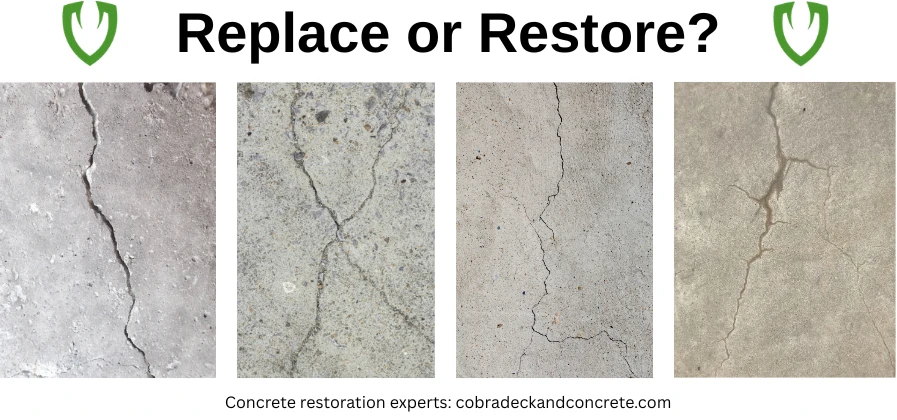
Small, stable cracks may be repairable before coating, but widening cracks, vertical displacement, or significant movement deserve closer inspection.
If a crack is going to move again, paint won’t stop it.
Repair the problem before covering it.
Drainage Matters Too
No coating can compensate for bad drainage.
Water should move toward drains instead of sitting across the deck.
Check:
- Deck drains
- Joints
- Low spots
- Transitions
- Radius drains
- Slope around the pool
Standing water increases slip risk, staining, organic growth, and moisture exposure.
The right pool deck coating should work with good drainage, not replace it.
What About Pool Chemicals?
Chlorine and other pool chemicals are unavoidable.
That makes chemical resistance important.
Polyaspartic and many polyurea systems perform well in this area. Epoxy can also provide strong resistance, depending on the formulation.
Whatever you choose, clean spills right away.
Chemical-resistant doesn’t mean chemical-proof.
Rubber and Metallic Coatings
Rubber coatings appeal to homeowners who want a softer surface and more traction.
They can work in specialized applications, but durability, cleanability, UV resistance, and appearance vary widely by product.
Metallic coatings can create dramatic finishes, but they are usually more design-driven. Dark or glossy metallic surfaces may absorb more heat and need additional texture around water.
For outdoor pool decks, comfort and safety should come before drama.
DIY or Professional Installation?
Some acrylic products are reasonable DIY projects.
Before starting, calculate the square feet of the deck and confirm:
- Coverage rate
- Number of coats
- Drying time
- Moisture requirements
- Surface preparation
- Weather conditions
- Primer or base coat
- When the deck can handle foot traffic
Advanced coating systems are much less forgiving.
Fast cure times sound convenient until the material begins setting before you’re ready.
That’s where professional installation can be, and usually is, worth the cost. When I started Cobra, I already had years of experience in the industry but was never satisfied with the usual process so I added a step with a proprietary mix. That addition and our full 12-month warranty helped Cobra book clients fast in our early days. Before you sacrifice time with your family or friends to DIY your deck, call us and we’ll take a look at your project. You’ll get a free quote from an expert and maybe pick up a few ideas you can use if you choose to go at your pool deck alone.
The Cheapest Pool Deck Paint Isn’t Always the Cheapest Option
Price per gallon is easy to compare.
Cost over the lifespan of your pool deck is harder.
Suppose one coating costs less today but needs frequent touch ups, recoating, or stripping.
Another costs more but provides a durable finish with less maintenance.
The cheapest bucket may not be the cheapest project.
That doesn’t mean every homeowner needs the most expensive coating.
It means you should think about the project as a long term investment.
Consider preparation, labor, expected service life, maintenance, repairability, comfort, safety, and appearance together.
That’s how you find the best option instead of just the lowest price.
Sometimes Restoration Is Better Than Painting
In my experience, this is the costliest part that a lot of people miss.
Your pool deck may not need paint at all.
If the concrete or decorative surface is structurally sound but looks worn from dirt, mildew, staining, or weathering, professional cleaning and restoration may be the smarter solution.
At Cobra, we’ve spent more than 12 years restoring outdoor surfaces throughout the Raleigh-Durham area.
We see this frequently around Raleigh, Cary, Durham, and Morrisville.
A homeowner looks at a tired pool deck and sees an expensive replacement project.
We look at it and ask a different question:
Can the pool deck surface you already have be restored?
Most of the time the answer is yes.
And that can save you from unnecessary coatings, expense, and maintenance.
How I’d Choose a Pool Deck Finish for My Own Home
I’d start with how the pool gets used.
If people are constantly walking barefoot, surface temperature matters.
If we have kids running around, slip resistance becomes a priority.
If the deck gets intense sun, I care about UV stability and color.
If there are constant parties and heavy foot traffic, durability moves higher on the list.
If the deck is shaded and gets organic growth, cleanability matters.
If I’m working with an older textured deck, I’d figure out what it is before covering it.
If I want minimum upkeep, I’d compare coatings based on real maintenance requirements rather than just initial appearance.
And if the concrete is already attractive but dirty?
I’d clean it before deciding anything.
That is the difference between shopping for paint and solving the actual problem.
Frequently Asked Questions About Pool Deck Paint and Coatings
What is the best pool deck paint for concrete?
If you specifically want paint rather than a multi coat resin system or cementitious overlay, a high quality exterior acrylic concrete deck paint is often a practical choice. The product should be designed for horizontal concrete, outdoor use, moisture, abrasion, UV exposure, and pool environments.
For greater durability, professionally installed polyaspartic coatings may be a better option than conventional paint.
What is the best pool deck coating for North Carolina?
There is no single answer for every deck.
For Triangle homeowners, I would prioritize UV resistance, moisture tolerance, traction, cleanability, temperature comfort, and the ability to handle seasonal temperature changes.
Polyaspartic systems can be an excellent choice for durability. Acrylic systems can make sense for budget and versatility. A genuine cool deck system may be better when barefoot temperature is the top concern.
Your existing surface ultimately determines the best pool deck coating.
Is polyaspartic better than epoxy for an outdoor pool deck?
Often, yes, especially when UV exposure is a concern.
Quality polyaspartic systems are available with excellent UV stability, chemical resistance, abrasion resistance, and fast curing. Some conventional epoxy coatings can yellow or fade with prolonged sunlight.
That doesn’t mean every polyaspartic product is superior to every epoxy product. Compare the actual systems and their intended uses.
Are polyaspartic coatings slippery around pools?
They can be if the finished surface is too smooth.
That’s why pool applications frequently incorporate texture, aggregate, quartz, decorative flake, or anti slip additives.
The goal is a surface that provides traction when wet without becoming painfully rough under bare feet.
What pool deck color stays coolest?
Generally, lighter colors absorb less solar energy than darker colors.
White, cream, light beige, sand, and pale gray will usually feel more comfortable in strong sun than dark charcoal or similar shades.
The coating chemistry and texture also affect surface temperatures, so color isn’t the only factor. And while a lighter color paint will feel cooler to the touch than a dark paint, it isn’t a replacement for a specially made cool deck paint.

Does cool deck paint really work?
Some products marketed as cool deck coatings are designed to reduce heat, but not every product works the same way.
The original Kool Deck system, developed by Mortex in 1962, is applied to wet concrete and creates a textured surface that’s specifically designed to lower surface temperature.
Ordinary light-colored paint will NOT perform exactly like a purpose-built cooling overlay.
Can I paint over Kool Deck?
Possibly, but understand what you may be giving up.
Mortex states that its Systex acrylic deck paint can be used on pool decks but warns that when applied over cool deck surfaces it makes the area hotter and slicker.
If you like the cooling performance of your existing deck, I strongly suggest you consider restoration before covering it.
How long does pool deck paint last?
There is no honest universal number.
The answer depends on the product, surface preparation, sunlight, moisture, traffic, concrete condition, drainage, maintenance, and installation quality.
A product installed correctly over stable concrete can perform dramatically better than the same product rolled over a poorly prepared surface.
Should I pressure wash a pool deck before painting it?
Cleaning is extremely important, but pressure washing should be done correctly.
The goal is to remove contaminants without damaging the concrete or forcing problems into weak areas.
After cleaning, the surface still needs to meet the coating manufacturer’s preparation and moisture requirements.
Pressure washing is preparation.
It is not necessarily the entire preparation process.
Can I paint a cracked concrete pool deck?
You can coat concrete with repaired cracks, but don’t assume paint will fix the crack.
Determine why the concrete cracked and whether the crack is stable first.
Moving, widening, or displaced cracks deserve closer inspection before the deck is coated.
Does a pool deck coating prevent water damage?
A properly selected coating or sealer can reduce water penetration, but it won’t correct failed drainage, structural cracks, or defective concrete.
Water still needs somewhere to go.
That’s why the condition of drains, joints, slopes, and the underlying concrete surface should be considered before coating the deck.
Is pool deck paint a good DIY project?
It can be.
Acrylic products intended for homeowners are much more approachable than advanced resin systems.
But don’t underestimate preparation and don’t assume this will be a quick Saturday afternoon project (it won’t).
Most failed DIY jobs I see don’t fail because someone couldn’t operate a roller.
They fail because something underneath the coating wasn’t ready.
Should I choose pool deck paint based on the number of colors available?
A wide range of colors is great, but don’t let color make the decision by itself.
Think about heat, slip resistance, UV exposure, surrounding architecture, landscaping, maintenance, and how the surface will look when wet.
The best color is the one that improves both the visual appeal and everyday usability of your outdoor space.
What is the lowest maintenance pool deck coating?
Premium resin systems such as polyaspartic coatings are often marketed for durability and less maintenance, and quality products can be very easy to clean.
But every surface needs maintenance eventually.
Leaves, organic growth, dirt, pool chemicals, spills, and weather don’t stop because the coating was expensive.
Regular cleaning helps protect the appearance and lifespan of your pool deck regardless of which finish you choose.
Before You Paint Your Pool Deck, Let Cobra Take a Look
A worn pool deck can make the entire pool deck and backyard feel older than it really is.
That doesn’t automatically mean you need a new coating.
Sometimes a deep professional cleaning can reveal a surface that still has plenty of life left. Sometimes the deck needs sealing or restoration. Sometimes a coating really is the best choice.
The important thing is knowing the difference before you spend the money.
At Cobra Deck & Concrete Restoration, we’ve been restoring outdoor surfaces in the Raleigh Durham area since 2012. We work with homeowners and properties throughout Morrisville, Cary, Durham, Raleigh, and surrounding communities. Our pool deck services are designed to clean, restore, and protect these surfaces so you can get more life and enjoyment out of the space you already have.
If your pool deck is stained, weathered, slippery, dirty, or simply looks like it has seen better days, you don’t have to guess what it needs.
Contact Cobra Deck & Concrete Restoration for a free inspection and quote.
We’ll look at the surface you actually have and help you determine the smartest way to bring it back.
Because the perfect pool deck isn’t the one with the fanciest coating name.
It’s the one you can walk onto on a summer afternoon, look around, and feel good about again.