If your driveway is gray with grime, your siding has turned green in the shade, or your deck is wearing a coat of North Carolina pollen, it’s tempting to grab the strongest washer you can find and blast it clean.
That’s how surfaces get scarred.
After more than 12 years restoring decks, concrete, patios, fences, and home exteriors throughout Morrisville, Cary, Raleigh, Durham, and the surrounding Triangle, I’ve learned that the most important question isn’t, “pressure washing or power washing?”
It’s this:
What are we cleaning, what’s stuck to it, and how much force can that surface safely take?
What’s the Difference Between Pressure Washing and Power Washing?
Both methods use pressurized water to clean outdoor surfaces.
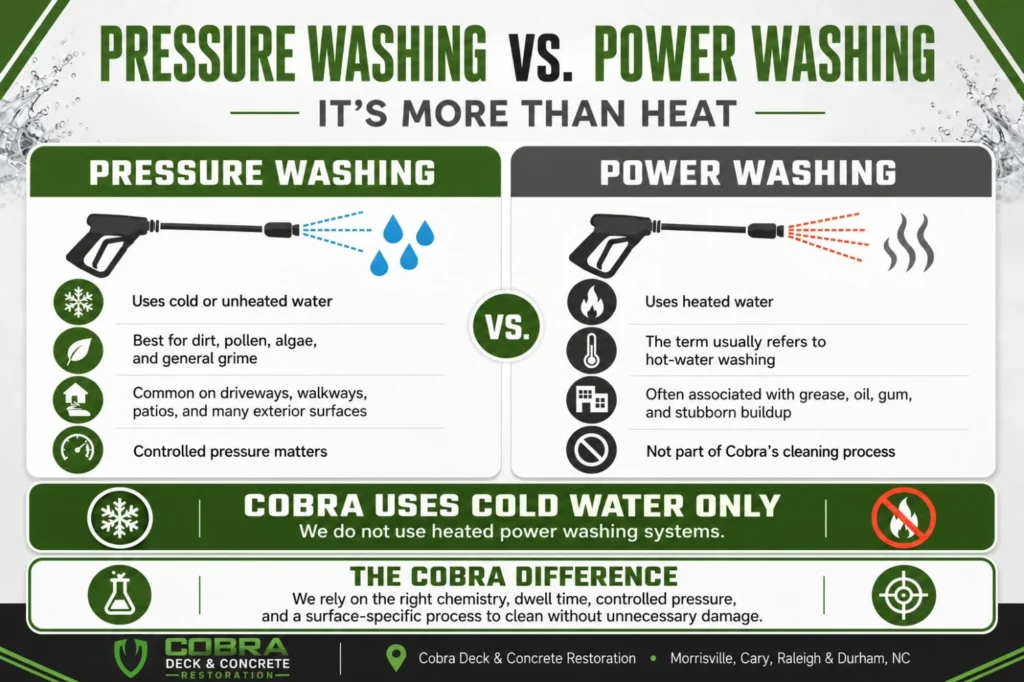
A pressure washer typically uses cold water or unheated water supplied through a garden hose, then pushes it through a pump to create a high-pressure stream.
A power washer works similarly, but power washing machines add a heating element or burner that raises the temperature of the water.
So the primary difference is water temperature.
In the pressure washing industry, you’ll often hear the term power washing used for equipment that heats the water. That’s the textbook distinction.
But here’s something important about how we work at Cobra that I’m very proud of: we don’t use heated water on any of our projects.
We don’t even own a hot water pressure washing system.
After more than 12 years restoring wood and concrete, we’ve found that the better question isn’t, “How hot can we make the water?” It’s, “What does this particular surface need to get clean without damaging it?”
For us, that means choosing the right cleaning agent, giving it time to work, and then using carefully controlled cold water pressure to finish the cleaning process.
The cleaner does much of the hard work. The pressure washer shouldn’t have to bully the surface into submission.
The Better Question: What Are You Cleaning?
This is where I think most pressure washing articles get the subject backward.
They start with the machine.
We start with the surface and specific problem.
A weathered wood deck isn’t concrete. A fence isn’t a pool deck. A previously coated concrete surface isn’t the same as a bare driveway. And algae growing on a shaded deck shouldn’t automatically be treated the same way as staining on concrete.
Most cleaning jobs around homes in our research triangle involve something different. And I have a solution for every one. Heat is never part of the fix – better chemistry is.
We see:
- Pollen
- Algae
- Mildew
- Mold-like organic growth
- Dirt
- Mud
- Leaf staining
- General weathering
- Grime collecting in shaded areas
That’s why Cobra uses cold water for every project and changes the cleaning process, not the water temperature.
On decks and fences, for example, we use a specialized phosphorus based exterior wood cleaner with no bleach or chlorine. It contains a surfactant that helps the cleaner cling to the wood long enough to loosen mold, mildew, dirt, and other buildup before we begin pressure washing.
That’s a very different approach from pointing a powerful machine at the wood and hoping pressure does all the work.
Concrete needs different chemistry. Depending on the project, we may safely use a bleach based solution as part of the cleaning process.
The important point is that there isn’t one Cobra formula for everything.
We match the cleaner, dwell time, pressure, and restoration process to the surface in front of us.
More PSI Does Not Automatically Mean a Better Clean
One of the biggest misconceptions I see is that more pressure must mean more cleaning power. PSI isn’t a scoreboard.
It doesn’t work that way.
PSI measures pounds per square inch. GPM measures how much water the machine moves. A professional pressure washer considers both, along with nozzle selection, distance from the surface, cleaning chemistry, dwell time, and the material being cleaned.
A high-pressure water spray may be perfect for tough dirt on sound concrete surfaces.
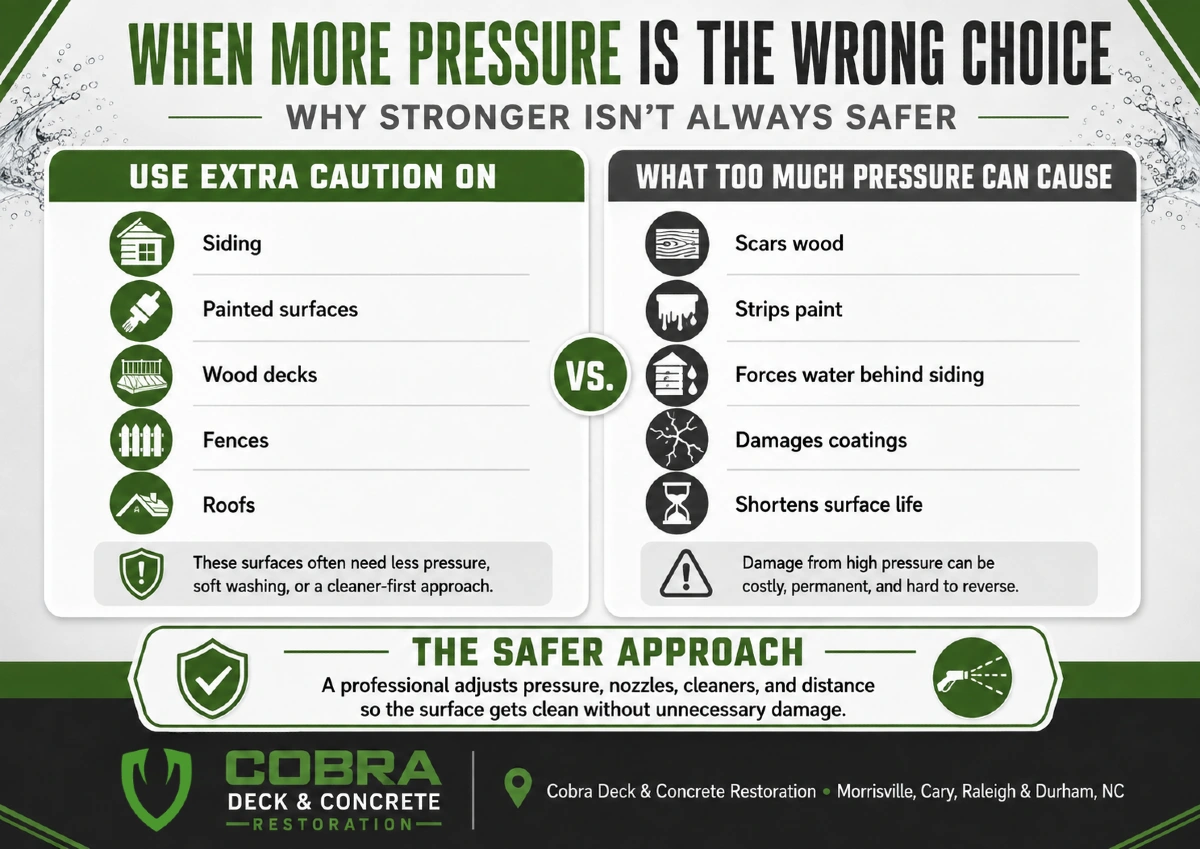
That same high water pressure can damage:
- Wood decking
- Fences
- Painted surfaces
- Siding
- Certain pavers
- Aging mortar
- Coated concrete
- Roofing materials
The goal of pressure cleaning isn’t to use as much pressure as possible.
The goal is to use only as much pressure as the cleaning task actually requires.
That distinction matters especially around older homes, weathered decks, and previously coated surfaces throughout the Triangle.
Where Soft Washing Fits In
This is where many pressure washing versus power washing comparisons fall comically short.
Soft washing relies on less pressure and lets cleaning solutions do more of the work.
Instead of trying to blast organic growth off a surface, a cleaning solution is applied and allowed to work. The surface can then be rinsed with lower pressure, reducing the risk of damage. Our proprietary solutions won’t damage your surfaces.
That makes soft washing a better option for many delicate surfaces and softer surfaces, including:
- Vinyl siding
- Painted exterior surfaces
- Certain wood surfaces
- Stucco
- Some roof-cleaning applications
At Cobra, this surface first thinking is especially important because much of our work involves restoring decks, fences, pool decks, and concrete rather than simply making something look clean for the afternoon.
Wood is a perfect example. Our cleaning systems are specifically designed around wood restoration, and our proprietary exterior wood cleaner lets us loosen contaminants before controlled cold water pressure is applied. That gives us a cleaner surface without depending on excessive pressure or heat.
Cleaning is important, but on a restoration project it’s often the beginning of the process, not the end.
Pressure Washing North Carolina Homes Is Different
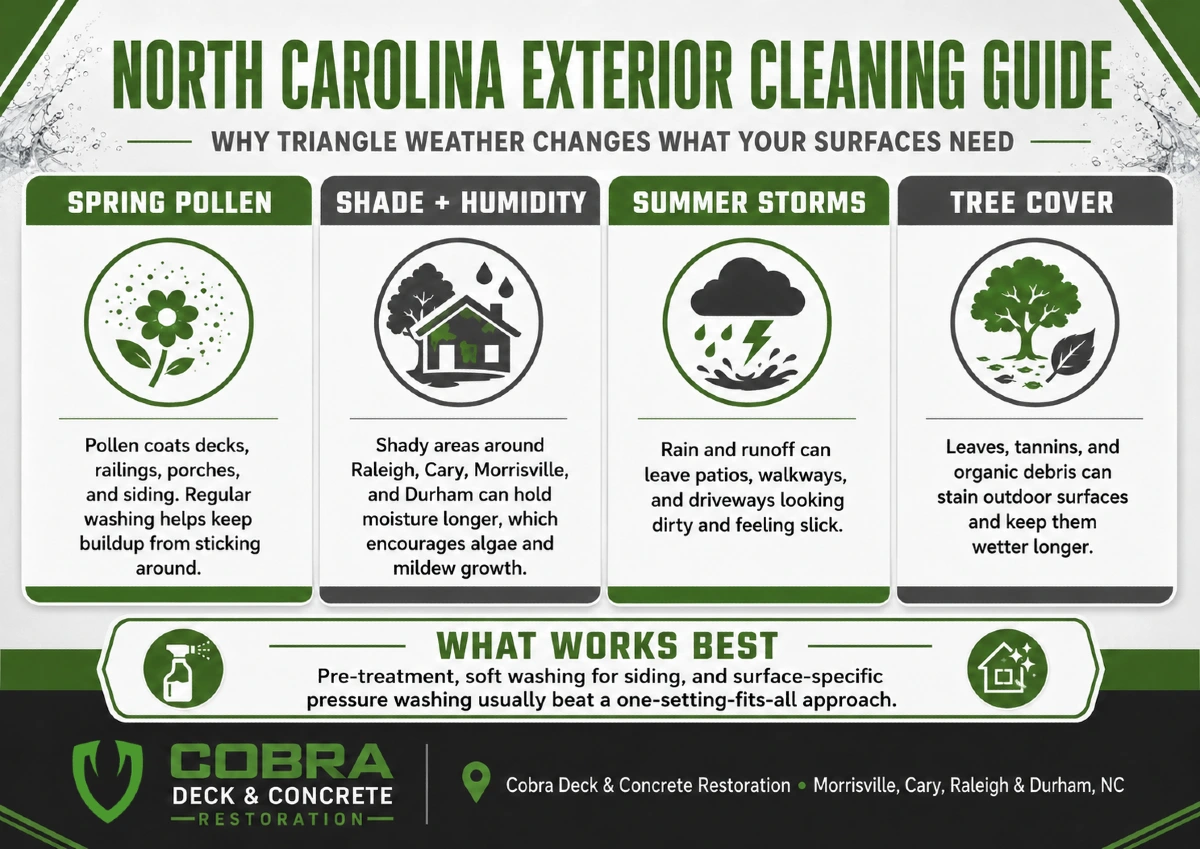
Living in the Triangle means dealing with a very specific combination of outdoor conditions.
We have long stretches of humidity, warm temperatures, tree cover, frequent summer storms, shaded neighborhoods, and an annual pollen season that North Carolina homeowners know all too well.
Those conditions affect how exterior surfaces age.
Pressure Washing in Raleigh, NC
Raleigh homes tend to age differently from one neighborhood to the next.
In established areas like North Hills, Five Points, Oakwood, and neighborhoods near the Beltline, mature tree cover can keep siding, walkways, retaining walls, and back patios shaded for long stretches of the day. That shade matters. Surfaces that dry slowly tend to hold onto moisture, organic growth, pollen, and leaf debris longer than areas exposed to direct sun.
We also see a lot of mixed-material properties in Raleigh. One home may have vinyl siding, painted trim, a wood deck, brick steps, and a concrete driveway all within a few feet of each other.
Those surfaces should not be cleaned with one pressure setting.
A driveway may respond well to controlled high pressure, while siding may need soft washing and an older wood deck may call for less pressure and more cleaning chemistry.
Raleigh’s heavy spring pollen is another issue. It doesn’t just make cars yellow. It settles into textured concrete, horizontal deck boards, porch ceilings, railings, and shaded siding, where it mixes with moisture and grime. And it feeds mold, mildew and algea.
That’s why our approach to pressure washing in Raleigh, NC starts with the surface and the contamination and never just how dirty something looks from the street.
Pressure Washing in Cary, NC
Cary properties present a different kind of cleaning challenge with outdoor living spaces and several finishes packed into one project.
We frequently see a home with a stained deck, screened porch, paver patio, concrete walkway, vinyl or fiber-cement siding, and landscaped beds all connected around the backyard. It’s complex from a cleaning standpoint.
That creates more opportunities for the wrong cleaning method to cause trouble.
A strong high-pressure water spray that works well on bare concrete will be too aggressive for stained wood or a coated surface. And overspray from the wrong cleaning solutions can damage the ornamental landscaping that’s only inches away from a patio or foundation wall.
Many Cary neighborhoods also have mature hardwoods that create attractive, shaded backyards. They’re beautiful but those same areas can stay damp after rain and collect leaf tannins, algae, mildew, and organic buildup.
For pressure washing in Cary, NC, we often spend as much time deciding what not to hit with high pressure as we do nailing down what to clean. It’s time-consuming for sure.
That restraint is important on decks in particular. A wood surface can look dramatically cleaner after aggressive washing while still being left with raised grain, etched fibers, or visible wand marks. And that’s not going to age well.
The goal is not a five-minute transformation.
It’s a clean surface that is still in good condition when the job is finished.
Pressure Washing in Morrisville, NC
Morrisville has grown quickly, and that shows up in the types of exterior cleaning jobs we see.
Many properties have newer siding, relatively compact lots, concrete driveways, small patios, townhome-style outdoor areas, and homes positioned close to neighboring structures. In those environments, control is really important.
Water and cleaning solution can travel farther than homeowners expect.
Windows, garage doors, landscaped beds, outdoor furniture, neighboring fences, and adjacent siding may all sit within the working area of a pressure washer.
That means pressure washing in Morrisville, NC isn’t just a matter of choosing a machine with high PSI and moving quickly.
Technique matters.
So does runoff management, nozzle selection, distance, and knowing when to switch to lower pressure.
Morrisville’s dense development can also create shaded side yards between homes where air movement and sunlight are limited. Those narrow areas are common places to find green buildup on siding, foundation surfaces, concrete pads, and fences.
Because Cobra Deck & Concrete Restoration is based in Morrisville, these are the kinds of local property conditions we work around regularly on our deck repair and restoration projects.
We know that a small patio tucked behind a townhome requires a very different cleaning process from a wide commercial concrete area. And we know that both are different from washing siding.
Pressure Washing in Durham, NC
Durham often needs the widest range of cleaning judgment of the many area cities we serve.
You can move from newer subdivisions to older neighborhoods with weathered wood, historic masonry, mature trees, painted porches, brick walkways, older concrete, and surfaces that may have been repaired or coated multiple times over the years.
That history makes a difference.
Older concrete can have weak edges or previous patchwork. Weathered deck boards are usually softer than they appear. Painted or previously stained wood can react unpredictably to high water pressure. Brick and mortar conditions can vary dramatically from one property to the next.
That makes a one-size-fits-all approach very risky.
For pressure washing in Durham, inspection is the most important part of the cleaning process.
Before increasing pressure, we want to know what we are actually looking at.
Is that dark area ordinary dirt?
Organic growth?
An oil stain?
A failing coating?
Weathered wood fiber?
Something that needs cleaning chemistry instead of more force?
Durham’s mature tree canopy creates persistent shade around decks, walkways, retaining walls, and north-facing sections of homes. It looks great but those damp areas tend to collect organic buildup faster and may take longer to dry after storms.
In those situations, the best method is often not the method that produces the most dramatic spray.
It’s the one matched carefully to the condition of the material underneath the grime.
Why Local Conditions Matter More Than a City Name
The important thing isn’t that a home happens to be in Raleigh, Cary, Morrisville, or Durham.
It’s what the property’s location tells us about the cleaning conditions.
A shaded Raleigh patio under mature oaks may need a different approach from a sunny Morrisville driveway. A weathered Durham porch may require far more caution than newer concrete in Cary. Two houses on the same street can even need completely different washing methods depending on tree cover, drainage, age, coatings, and previous maintenance.
That’s why we don’t treat local SEO as a reason to repeat city names.
For us, local experience should mean something practical.
It means understanding what Triangle weather does to exterior surfaces, recognizing the kinds of materials found throughout local neighborhoods, and choosing the right cleaning method for the property in front of us.
How Cobra Approaches Different Outdoor Surfaces
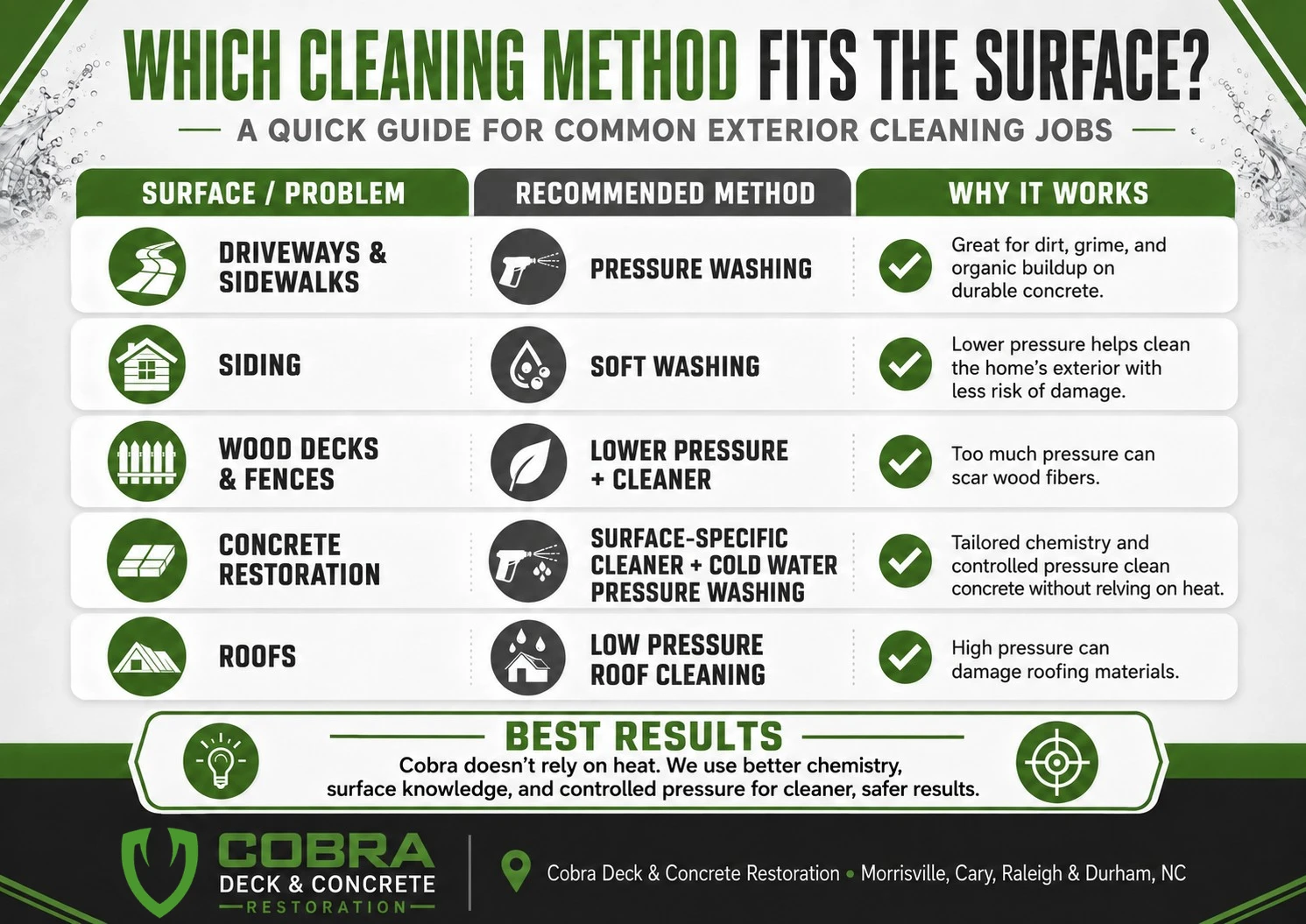
| Surface or Project | Cobra's Approach | Why |
|---|---|---|
| Weathered wood deck | Specialized wood cleaner + controlled cold water pressure | The cleaner loosens mold, mildew, dirt, and buildup so excessive pressure isn't needed. |
| Wood fence | Wood-safe cleaner + controlled cold water pressure | Helps remove organic buildup while reducing unnecessary stress on the wood fibers. |
| Concrete restoration | Surface-specific cleaning solution + cold water pressure washing | Concrete needs different chemistry than wood, and the process is adjusted to the condition of the surface. |
| Pool deck | Surface and coating-specific cleaning | Coatings, textured finishes, and existing surface conditions can require different cleaning methods. |
| Previously coated concrete | Inspection + tailored cleaning and preparation | Existing coatings and surface condition determine how aggressively the area should be cleaned and prepared. |
| Driveway during a restoration project | Controlled cold water pressure washing | It can make sense to clean an adjacent driveway when the Cobra Crew and equipment are already onsite for a larger restoration project. |
The important thing isn’t whether a company calls the service pressure washing or power washing.
It’s whether they know when to change methods.
So Why Doesn't Cobra Use Hot Water?
We don’t need it for the restoration work we specialize in.
Cobra uses cold water on every project.
Instead of relying on heat to solve a cleaning problem, we match the cleaning agent and process to the material we’re restoring.
That’s especially important with wood.
Our pressure washing systems and cleaning process have been developed around cleaning decks and fences without unnecessarily damaging the wood fibers. The cleaning solution loosens the contamination first. Controlled pressure then removes it.
For concrete, we change the chemistry and process because concrete has completely different needs.
Could another contractor have a legitimate use for heated water on a greasy industrial cleaning job? Certainly.
But that isn’t Cobra’s specialty and I’ve spent the last 12 years fine-tuning our process to guarantee results without risking any damage.
Our specialty is restoring and protecting outdoor surfaces, and we’ve built our cleaning process around that job.
Can You Do It Yourself?
For regular household use, an electric motor pressure washer can be useful for small cleaning jobs.
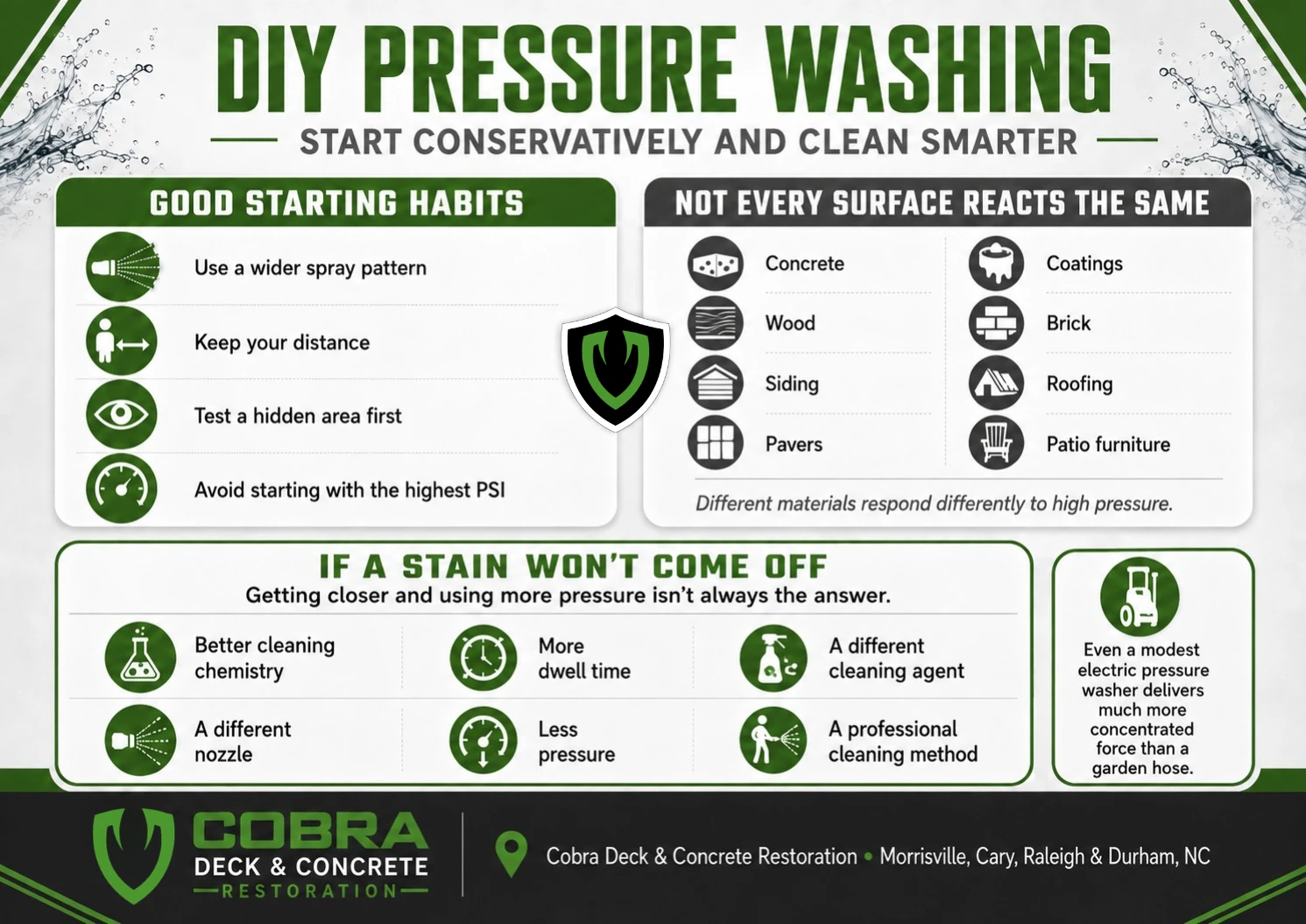
But even a relatively modest machine produces far more concentrated force than a garden hose.
If you decide to clean something yourself, start conservatively:
- Use a wider spray pattern.
- Keep your distance.
- Test a hidden area.
- Avoid immediately reaching for the highest PSI setting.
Most importantly, don’t assume every outdoor surface should be cleaned the same way.
Concrete, wood, siding, pavers, coatings, brick, roofing, and patio furniture all respond differently to high pressure.
If a stain doesn’t come off, getting closer and using more pressure isn’t always the answer.
Sometimes you need:
- Better cleaning chemistry
- More dwell time
- A different cleaning agent
- A different nozzle
- Less pressure
- A professional cleaning method
It Comes Down to Control & Judgment
People use the terms power washing and pressure washing interchangeably all the time.
For normal conversation, that’s not a big deal.
What matters more is the judgment of the person holding the wand.
Can they identify when cold water is enough?
Do they understand which cleaning agent the surface needs and how long it should be allowed to work?
Do they understand the difference between cleaning a surface and preparing it for restoration?
Can they recognize a surface that requires less pressure?
Do they understand when cleaning solutions should do the heavy lifting?
Can they clean a large driveway evenly without leaving visible stripes?
Can they clean wood without carving lines into it?
Do they know when high PSI creates more risk than benefit?
Those are the important differences.
Cobra Isn't a Quick Wash Company
This is worth explaining because our business has changed over the years.
Cobra Deck & Concrete Restoration isn’t built around inexpensive, one surface pressure washing jobs.
You can find plenty of companies willing to pull up, pressure wash a small driveway, charge $100 cash, and move on. For a straightforward driveway wash, you don’t necessarily need a restoration specialist.
Our crews focus on projects where experience, surface knowledge, preparation, and the steps after cleaning actually matter.
That means deck restoration, fence restoration, concrete restoration, pool decks, coated surfaces, and larger outdoor restoration projects throughout Morrisville, Cary, Raleigh, Durham, and the surrounding Triangle.
Cleaning is part of that work, but it’s only one part.
Our philosophy is simple:
Clean. Seal. Protect.
We clean the surface properly. We prepare it for the next stage. Then we use the appropriate stain, sealer, or coating to help protect it and improve how it looks and performs.
That’s why no two Cobra projects are treated exactly the same.
If we’re already restoring your deck, pool deck, or another outdoor surface and your driveway needs attention too, absolutely ask us about it. Since the Cobra Crew and equipment are already on the property, pressure washing an adjacent driveway can make perfect sense as part of the larger project and we’ll happily do it.
What we don’t try to be is the cheapest company in town for a small standalone driveway wash. That’s not us.
I’d rather put our crews and experience into the restoration projects we’re built to do exceptionally well.
When You Need More Than a Pressure Wash
If your deck, fence, pool deck, concrete, or outdoor living space needs more than a quick cleaning, talk with Cobra Deck & Concrete Restoration.
We’ve spent more than 12 years learning how Triangle weather, humidity, pollen, organic growth, aging, and previous coatings affect outdoor surfaces.
We’ll look at what’s actually happening, choose the right cleaning and restoration process, and recommend what the surface needs next.
Request a free restoration estimate from Cobra in Morrisville, Cary, Raleigh, Durham, or the surrounding Triangle.
Because getting something clean is one thing.
Cleaning it correctly so you can protect it for what comes next is another.