If you’re looking at a faded, gray deck in October and wondering whether you missed your chance, you probably haven’t. In most of the Triangle, fall is one of the best times of year to stain a deck. The heat and humidity of summer are gone, the pine pollen is months away, and the wood has had all summer to dry out.
The catch is that the window closes. Once nights get cold and mornings stay wet, stain stops curing the way it should. In Raleigh, Cary, Morrisville and Durham, that usually happens sometime in November. North of Wake Forest and out toward Lake Gaston, it tends to come a little sooner.
The short answer: if your deck can get a few dry days with daytime temperatures in the 60s or higher and nights that stay well above freezing, you can still stain it this fall. If not, the right move is to clean it now and stain it in spring. Below, I explain what the stain actually needs, how frost timing plays out across the Triangle, and what that means for your town. Don’t assume that every microclimate is the same throughout our region. You may not feel a difference when you drive from Lake Gaston to Morrisville, but wood experiences that slight change. For example, if you’re north of Raleigh, you’ll deal with frost first and on pine decks, that takes a toll fast.
What stain needs to cure properly
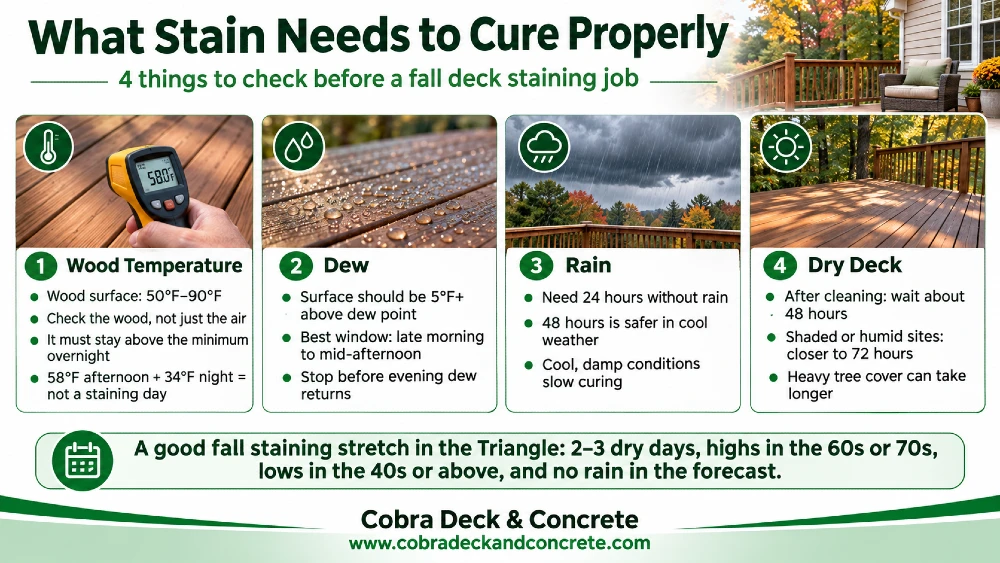
Stain has to soak into the wood and then cure. Cold, damp conditions slow both steps, which is how you end up with a finish that stays tacky, looks blotchy, or peels by spring. Before any fall stain job, we check four things.
- Temperature of the wood, not just the air. Most deck stains are made to go on between about 50°F and 90°F, and that range refers to the deck surface. The surface also has to stay above the minimum until the stain cures, including overnight. A 58°F afternoon followed by a 34°F night is not a staining day.
- Dew. Fall mornings in the Triangle are often soaking wet until late morning, and dew starts forming again in late afternoon. Many manufacturers want the surface at least 5°F warmer than the dew point. In practice, that means staining from late morning to mid-afternoon and stopping well before the evening dew sets in.
- Rain. Most stains need at least 24 hours without rain after application, and 48 hours is safer when it’s cool, because everything dries more slowly.
- A dry deck to start. After cleaning, wood needs about 48 hours to dry, and closer to 72 hours on shaded or humid sites. In fall, a deck under heavy tree cover can take longer than that.
Put those together and a good fall staining stretch in the Triangle looks like this: two or three dry days in a row, highs in the 60s or 70s, lows staying in the 40s or above, and no rain in the forecast. October usually has plenty of those days. By mid-to-late November they get scarce.
When the window closes in the Triangle
Central North Carolina’s first frost comes around October 27 on average, and the first real freeze usually follows a week or two later. Those are averages, and recent falls have often run later. Towns north of Raleigh, like Louisburg, typically see frost about a week earlier than the Raleigh area.
In my experience, frost alone doesn’t ruin a stain job. Once frost season starts, cold nights and long wet mornings shrink each day’s working window to just a few hours. And that’s why we treat early-to-mid November as the practical end of fall staining for most of the Triangle, and late October for the northern edge of our service area.
The best reason not to wait until spring is just a matter of protection. A deck stained in fall goes into winter protected from moisture, and it’s ready to use the first warm weekend in March. A deck left bare sits wet all winter. Then spring brings the yellow pine pollen that coats everything in the Triangle, which pushes most spring staining into late April or May, right when everyone else is trying to book. (I wrote more about pollen and humidity in Deck Restoration in the Research Triangle.)
Fall deck staining across the Triangle, town by town
Morrisville and Cary
Apex, Holly Springs and Fuquay-Varina
Raleigh and Garner
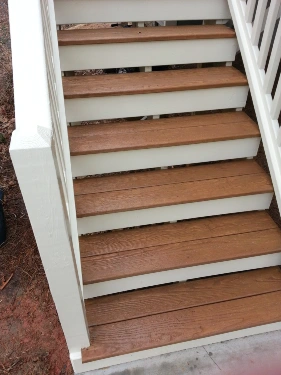
Durham and Chapel Hill
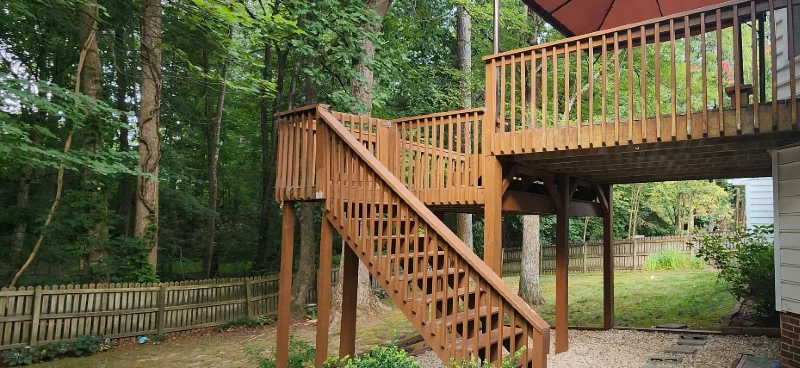
Wake Forest, Rolesville, Youngsville and points north
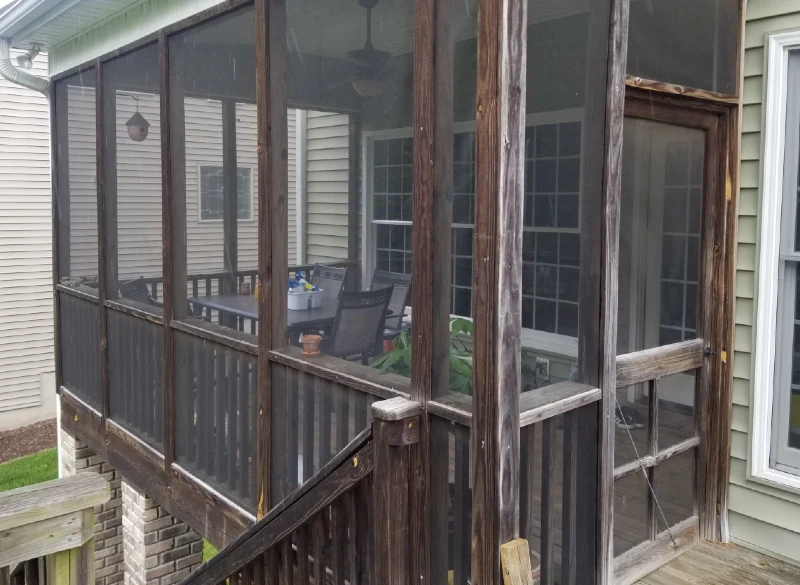
Clayton, Knightdale, Wendell and Zebulon
East of Raleigh, lots are often larger, and many homeowners have long fence runs as well as a deck. Fences are more forgiving in cool weather than decks because they shed water and don’t take foot traffic, so a deck-and-fence project here can often run a little later into the season.
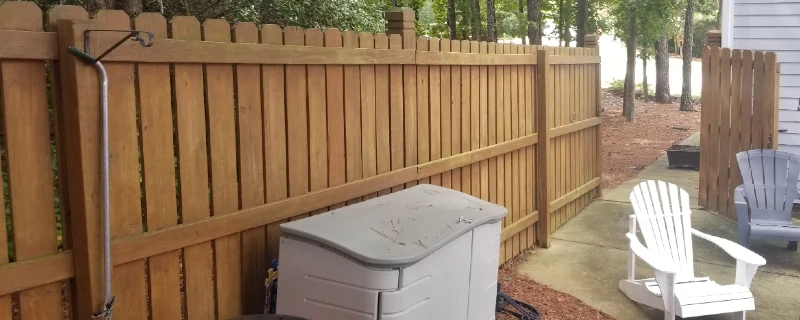
Lake Gaston
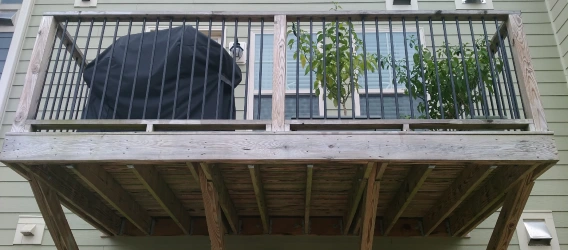
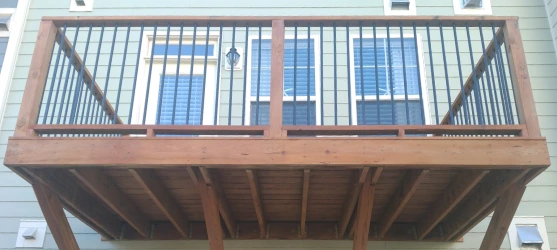
What if you miss the window?
You have two good options, and neither is “do nothing until summer.”
- Clean now, stain in spring. A professional cleaning removes mildew, algae, leaf stains and dirt before they sit on the wood all winter. It also gets you on the schedule early for spring, before the pollen clears and everyone calls at once.
- Get a free inspection now. Fall is a good time to find soft boards, loose railings or rot while you can still plan for it. If something looks structural, our post on whether a deck can be repaired or needs replacing walks through how to tell.
How we handle a fall stain job
Our deck restoration process is the same three steps year-round. What changes in fall is the scheduling.
- Presoak foam. Our cleaning foam soaks into the wood and lifts dirt, mold and grime, so the wash can be gentle and won’t scar the boards.
- Power clean. A controlled rinse washes away everything the foam loosened.
- Protective finish. We apply a stain or sealer with UV protection and water repellency once the wood is dry.
In fall, we watch the 10-day forecast closely and only stain inside a dry window with workable overnight lows. If the weather turns, we’d rather move your stain day than put product down in conditions that will shorten its life.
Deck restoration starts at $2.25 per square foot, and fence restoration starts at $6.00 per linear foot. See our pricing page for details.
Fall deck staining FAQ
Is it too cold to stain my deck in November? Not always, but it gets risky. You need daytime surface temperatures of at least 50°F that hold until the stain cures, plus 24 to 48 hours without rain. In most of the Triangle, early November can work; late November usually can’t.
What time of day should I stain in the fall? Late morning to mid-afternoon, once the dew has burned off and before evening dew returns.
How long after cleaning can I stain? About 48 hours on an open, sunny deck and 72 hours or more on a shaded or humid one. In fall, give it extra time.
Can I stain a new pressure-treated deck this fall? Often, yes, if the wood has dried out enough to absorb stain. A simple test: sprinkle water on the boards. If it soaks in, the wood is ready; if it beads up, wait.
Is fall better than spring for staining in North Carolina? For many Triangle homeowners, yes. Fall has milder temperatures and none of the spring pine pollen, and the deck heads into winter protected.
Book before the window closes
We’re scheduling fall deck and fence staining across Raleigh, Cary, Morrisville, Apex, Durham, Chapel Hill, Wake Forest and the rest of the Triangle. Request a free inspection or call us at 919.808.4485, and ask about $100 off your first treatment when you start a deck restoration plan.